Guide 06 Bahá'í literature independent reference
The Bahá'í World Centre: Haifa, Mount Carmel and 'Akká
Haifa and 'Akká, in northern Israel, are the centre of the Bahá'í Faith in both a spiritual and an administrative sense. This page explains why, and what the sites are.
Two cities, one World Centre
The Bahá'í World Centre is not a single building but a set of holy places and institutions in and around Haifa and the old walled city of 'Akká (Acre). The link with the region comes from history. Bahá'u'lláh was sent there in 1868 as a prisoner of the Ottoman Empire, spent the rest of his life in and near 'Akká, and died there in 1892.
The Shrine of the Báb on Mount Carmel
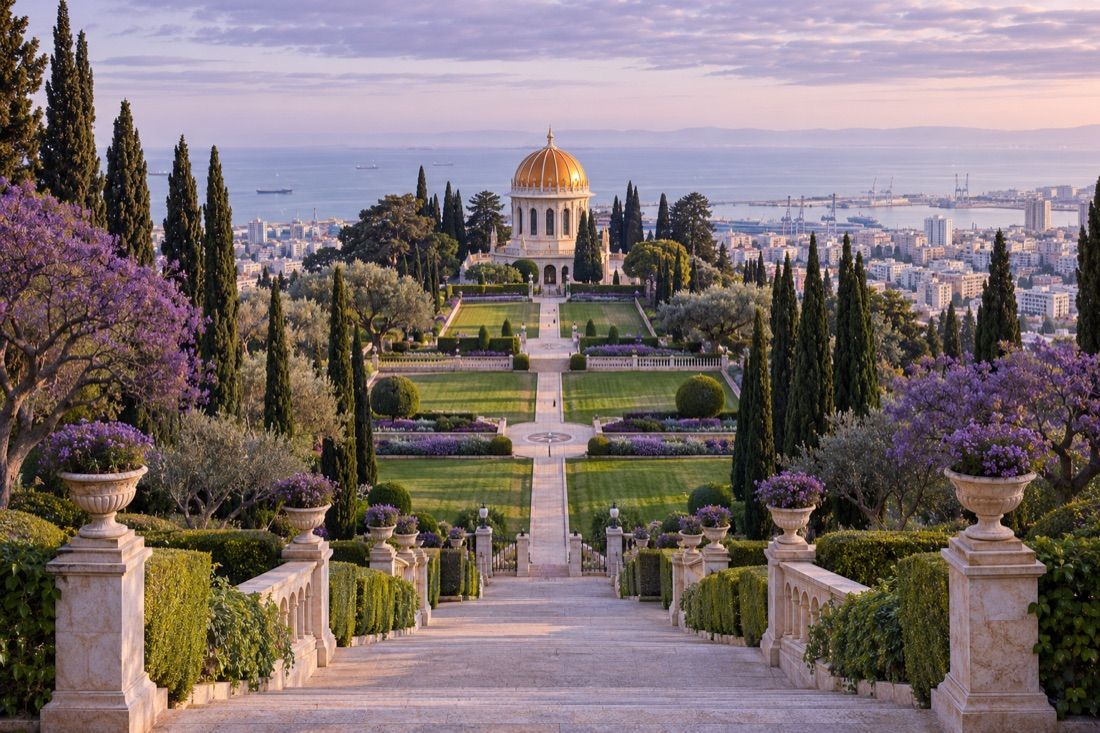
The Báb was executed in Tabriz in 1850, and his remains were brought to the Holy Land and placed in a shrine on Mount Carmel in 1909, built by 'Abdu'l-Bahá. The golden dome and the surrounding colonnade were added to the building later, and the dome was completed in 1953. The shrine is a small structure of stone and is visible across much of Haifa Bay.
The terraces
Below and above the shrine run formal gardens laid out on nineteen terraces, which were opened to visitors in 2001. The number again reflects the nineteen of the Badíʿ calendar. The gardens are tended by staff and volunteers, and they are among the best known tourist sights of the city. Rules on dress, photography and visiting days are set by the Bahá'í World Centre and change, so check the official pages before travelling.
The Shrine of Bahá'u'lláh at Bahjí
North of Haifa, near 'Akká, is the Shrine of Bahá'u'lláh at Bahjí, where he is buried. For Bahá'ís it is the Qiblih, the point toward which they turn when they say the obligatory prayer. The shrine is set in a garden beside the mansion where he spent his last years.
The Universal House of Justice
The Universal House of Justice is the governing council of the Bahá'í Faith. Its nine members are elected every five years by delegates from the national Bahá'í communities. It was first elected in 1963 and has its seat on Mount Carmel, in a building of white marble with a colonnade that was completed in the early 1980s.
World Heritage listing
In 2008 UNESCO placed the Bahá'í Holy Places in Haifa and the Western Galilee on the World Heritage List. The entry recognises the shrines and the gardens as places of pilgrimage and as an example of landscape architecture. For the story that led there, see the history guide.
Visiting
Visits to the gardens are open to the public on stated days, and the Bahá'í World Centre publishes the current hours, entry points and conditions. This site is not affiliated with any Bahá'í institution, so it cannot give those details. Pilgrimage in the Bahá'í sense is arranged through the Bahá'í World Centre and is separate from a tourist visit.